How It Works: CUDA Implementation
This page provides a detailed technical explanation of PyLO’s CUDA implementation.
Overview: The Performance Challenge
Naive implementations of learned optimizers face a fundamental performance bottleneck. To understand why, let’s examine what happens during a single optimizer step.
The Naive Approach
For a parameter tensor of size m × n, a naive PyTorch implementation:
Constructs features: Creates a tensor of size (m×n) × d_feat where d_feat ≈ 29-39
Computes statistics: Reduces each feature dimension to compute normalization factors
Normalizes features: Divides each feature by its normalization factor
Applies MLP: Evaluates a small neural network for each of the m×n parameters
Applies updates: Computes and applies the parameter updates
The problem: Each of these steps launches separate CUDA kernels, and all intermediate results are materialized in GPU global memory.
This results in optimizer steps that are 10-50× slower than traditional optimizers!
The Performance Profiler View
Here’s what the CUDA profiler shows for the naive implementation vs CUDA implementation:
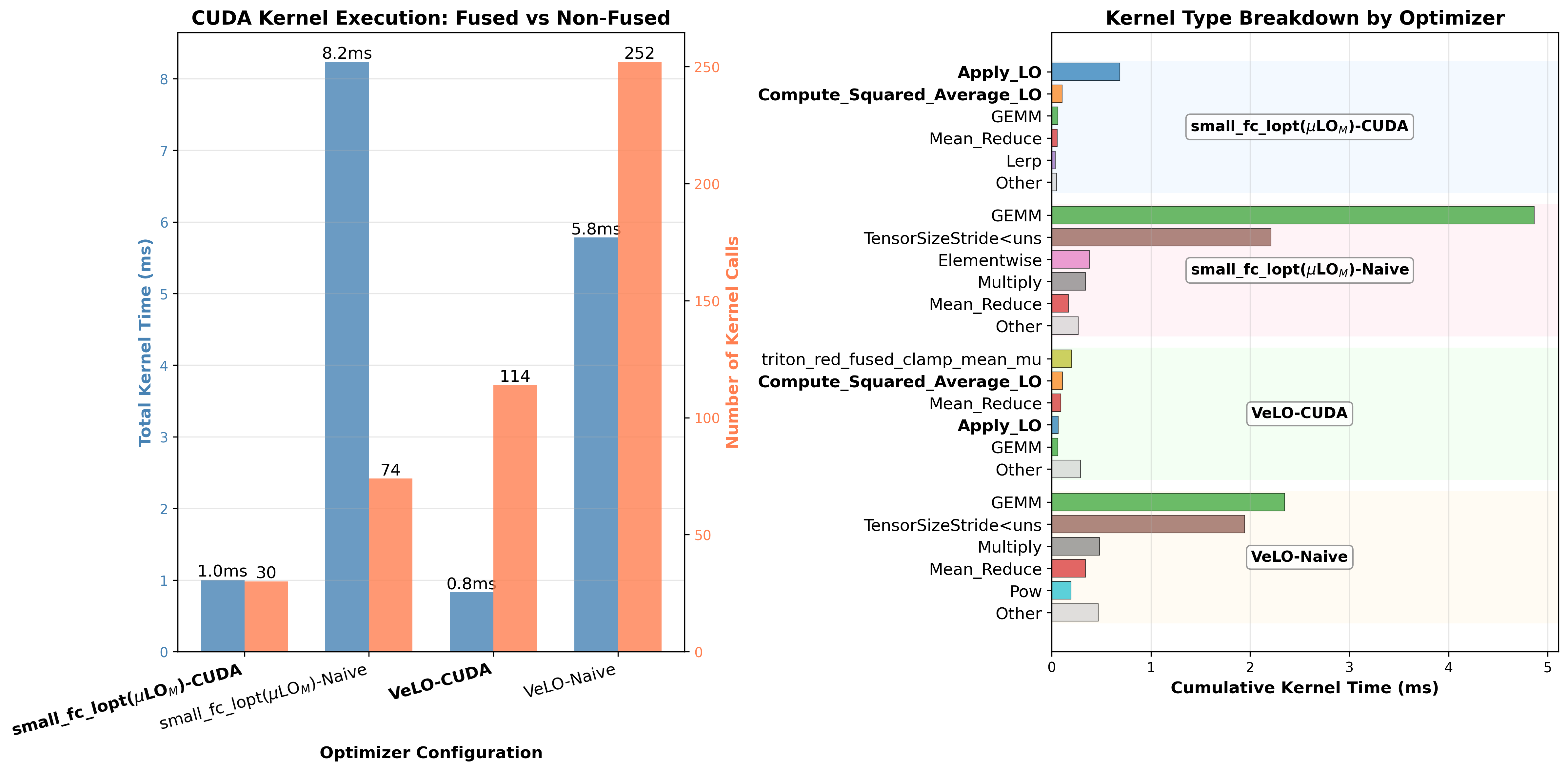
PyLO’s Solution: Fused CUDA Kernels
PyLO eliminates the bottleneck by fusing all operations into just 2 CUDA kernels that carefully manage the GPU memory hierarchy.
The Two-Kernel Architecture
Kernel 1: Feature Statistics Collection
Computes normalization statistics without materializing the full feature tensor:
Input:  gradients, parameters, accumulators (m, v, r, c)
Output: d_feat normalization statistics (just 39 scalars)

For each parameter element (in parallel):
    1. Load gradient, parameter, accumulators from global memory
    2. Compute features in registers (39 values)
    3. Accumulate feature² in register array
    4. Reduce within warp using shuffle operations
    5. Reduce within block using shared memory
    6. Atomic add to global statistics
Kernel 2: Feature Construction and MLP Application
Applies the learned optimizer using the computed statistics:
Input:  gradients, parameters, accumulators, statistics
Output: updated parameters

Load statistics into shared memory (broadcast to all threads)

For each parameter element (in parallel):
    1. Load gradient, parameter, accumulators from global memory
    2. Compute features in registers (39 values)
    3. Normalize using statistics from shared memory
    4. Evaluate MLP in registers:
       - hidden = ReLU(W1 × features + b1)
       - hidden = ReLU(W2 × hidden + b2)
       - direction, magnitude = W3 × hidden + b3
    5. Compute update: direction × exp(magnitude × α) × β
    6. Write updated parameter to global memory
All intermediate values stay in registers and nothing materialized to global memory!
Performance Results
The fused implementation delivers dramatic speedups:
ViT-B/16 (batch size 32):
├─ Naive small_fc_lopt: 756.80 ms/step
├─ CUDA small_fc_lopt:  99.59 ms/step  → 86% reduction
├─ Naive VeLO:          585.11 ms/step
└─ CUDA VeLO:          113.58 ms/step  → 80% reduction

GPT-2 355M (batch size 4, seq length 1024):
├─ Naive small_fc_lopt: 2872.17 ms/step
├─ CUDA small_fc_lopt:   319.14 ms/step → 88% reduction
├─ Naive VeLO:          2378.93 ms/step
└─ CUDA VeLO:            284.37 ms/step → 88% reduction
Detailed Implementation
Kernel 1: Feature Statistics Collection
Here’s the high-level algorithm for Kernel 1:
__global__ void compute_feature_statistics(
    const float* __restrict__ grad,
    const float* __restrict__ param,
    const float* __restrict__ momentum,
    const float* __restrict__ second_moment,
    const float* __restrict__ row_factors,
    const float* __restrict__ col_factors,
    float* __restrict__ global_stats,
    int m, int n, int step)
{
    // Thread-local accumulator in registers
    float thread_stats[D_FEAT] = {0.0f};

    // Grid-stride loop over all parameters
    for (int idx = blockIdx.x * blockDim.x + threadIdx.x;
         idx < m * n;
         idx += blockDim.x * gridDim.x)
    {
        // Load inputs from global memory
        float g = grad[idx];
        float p = param[idx];
        float mv = momentum[idx];
        float v = second_moment[idx];
        // ... load row/col factors ...

        // Compute all features in registers
        float features[D_FEAT];
        compute_features(features, g, p, mv, v, ...);

        // Accumulate feature²
        #pragma unroll
        for (int i = 0; i < D_FEAT; ++i) {
            thread_stats[i] += features[i] * features[i];
        }
    }

    // Reduce within warp using shuffle
    #pragma unroll
    for (int i = 0; i < D_FEAT; ++i) {
        for (int offset = 16; offset > 0; offset /= 2) {
            thread_stats[i] += __shfl_down_sync(0xffffffff,
                                                 thread_stats[i],
                                                 offset);
        }
    }

    // Write warp results to shared memory
    __shared__ float smem[32][D_FEAT];
    if (threadIdx.x % 32 == 0) {
        int warp_id = threadIdx.x / 32;
        #pragma unroll
        for (int i = 0; i < D_FEAT; ++i) {
            smem[warp_id][i] = thread_stats[i];
        }
    }
    __syncthreads();

    // Final reduction and atomic add to global memory
    if (threadIdx.x < D_FEAT) {
        float sum = 0.0f;
        for (int w = 0; w < blockDim.x / 32; ++w) {
            sum += smem[w][threadIdx.x];
        }
        atomicAdd(&global_stats[threadIdx.x], sum);
    }
}
Kernel 2: Fused Feature Construction and MLP Application
Here’s the high-level algorithm for Kernel 2:
__global__ void apply_learned_optimizer(
    float* __restrict__ param,
    const float* __restrict__ grad,
    const float* __restrict__ momentum,
    const float* __restrict__ second_moment,
    const float* __restrict__ row_factors,
    const float* __restrict__ col_factors,
    const float* __restrict__ global_stats,
    const float* __restrict__ mlp_weights,
    int m, int n, int step)
{
    // Load normalization statistics to shared memory
    __shared__ float norm_stats[D_FEAT];
    if (threadIdx.x < D_FEAT) {
        float stat = global_stats[threadIdx.x];
        norm_stats[threadIdx.x] = rsqrtf(stat / (m * n) + 1e-8f);
    }
    __syncthreads();

    // Grid-stride loop over all parameters
    for (int idx = blockIdx.x * blockDim.x + threadIdx.x;
         idx < m * n;
         idx += blockDim.x * gridDim.x)
    {
        // Load inputs from global memory
        float g = grad[idx];
        float p = param[idx];
        float mv = momentum[idx];
        float v = second_moment[idx];
        // ... load row/col factors ...

        // Compute features in registers
        float features[D_FEAT];
        compute_features(features, g, p, mv, v, ...);

        // Normalize features using shared memory broadcast
        #pragma unroll
        for (int i = 0; i < D_FEAT; ++i) {
            features[i] *= norm_stats[i];
        }

        // Inline MLP evaluation (all in registers)
        float hidden1[HIDDEN_DIM];
        mlp_layer(hidden1, features, mlp_weights, 0);  // Layer 1
        relu(hidden1, HIDDEN_DIM);

        float hidden2[HIDDEN_DIM];
        mlp_layer(hidden2, hidden1, mlp_weights, 1);   // Layer 2
        relu(hidden2, HIDDEN_DIM);

        float output[2];  // [direction, magnitude]
        mlp_layer(output, hidden2, mlp_weights, 2);    // Layer 3

        // Compute update
        float direction = output[0];
        float magnitude = output[1];
        float update = direction * expf(magnitude * 0.01f) * 0.01f;

        // Write updated parameter to global memory
        param[idx] = p - update;
    }
}